
Research brief: Decoding sun and shadow underneath black walnut’s dappled canopy
New Mizzou Center for Agroforestry research investigates suitable black walnut cultivars for winter alley cropping systems based on available sunlight in early-spring.
Alley cropping is an agroforestry practice that integrates trees with other crops grown in the alleys between them. These systems have the potential to diversify income and nutritional output for farms, while improving soil health and other ecosystem services. While many rowcrop farmers express understandable concerns about tree crops decreasing productivity and jeopardizing available resources like sunlight, water and nutrients, an intentional alley cropping design offers another way forward, where both trees and annual crops are intensively managed to minimize competition for resources, while raising two (or more) agriculture products on one unit of land.
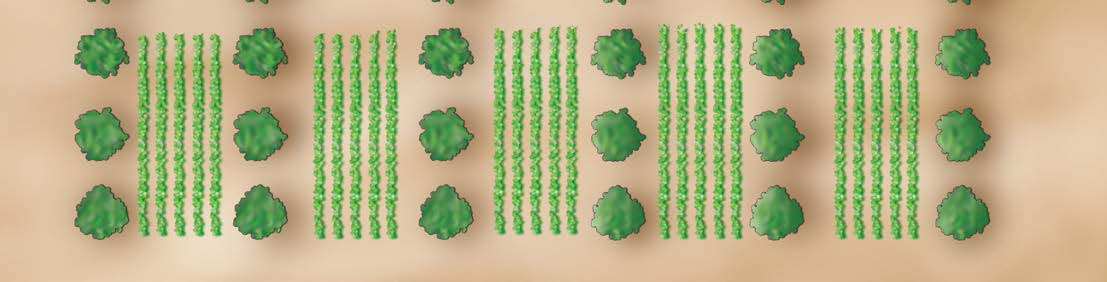
While more research is needed to better understand the specific benefits and limitations of tree/crop combinations, system design, including species selection, and management decisions, like pruning, can go a long way in setting up an alley crop for long-term success. Black walnut is considered a superior candidate for alley cropping due to its compound leaf structure that lets light through to the ground below. But which available cultivars allow for the crops below to capture the most sunlight? To begin to answer this question, researchers at the Center for Agroforestry conducted a study to investigate how the leafing patterns of 11 black walnut cultivars impact the amount of sunlight available in the understory.
Black Walnut & Winter Alley Cropping
Sunlight is a vital resource for crop growth. As alley cropping systems mature and tree canopies stretch over alleyways, leaf cover can impede adequate sunlight reaching the crop below. One solution to this limitation is to produce a winter alley crop, like grains, leafy greens, or brassicas, that ripen while trees are dormant. For these systems, late-leafing trees and those with open canopy structures offer the understory crop more time to mature before being shaded out.
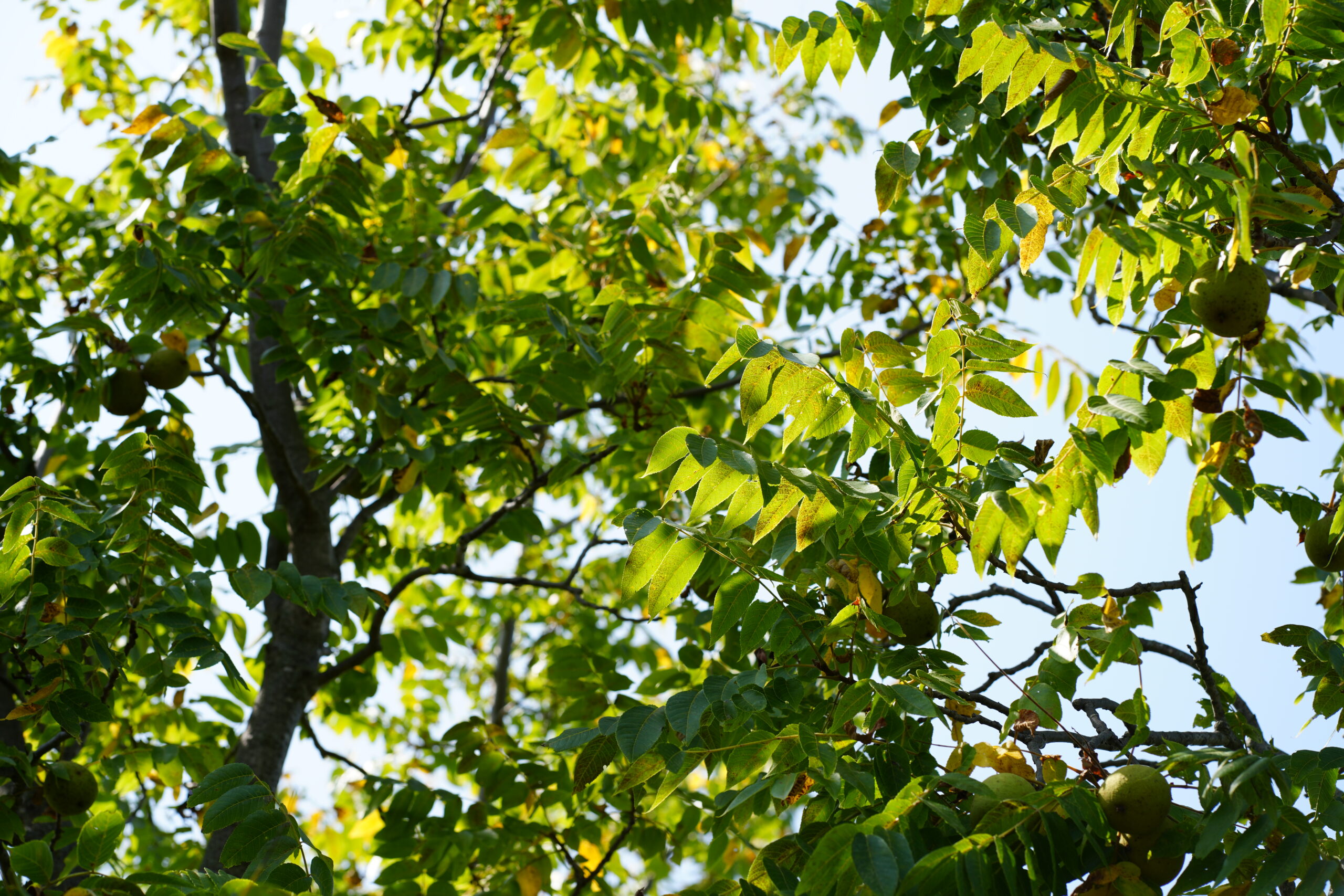
This research shows that some black walnut cultivars are more “cooperative” in this way than others. Black walnut is a well-adapted tree, native to eastern and central North America that provides healthy, marketable nuts in addition to many notable habitat and ecosystem benefits. Black walnut trees are fairly late to open their leaves, or “break bud” in the spring, allowing for more light to reach the ground below while their branches are still bare. Many commercially available black walnut cultivars were selected from northern environments, further emphasizing this characteristic of late-leafing to avoid being stunted by frost events. Once unfurled, their compound leaves allow light to shine through to understory crops. Annual crops that mature in early-spring, like winter wheat and barley, pair well with black walnut as an alley crop because their sunlight requirements can be met ahead of black walnut’s growing season.
Variation among black walnut cultivars
In a farm economy that increasingly hinges on efficiency, the best-suited cultivars are needed to boost productivity and profitability of these novel agroforestry systems. This research determined that bud break timing across the study’s eleven cultivars varied by a month (April 8 to May 7). ‘Schessler’ initiated its bud break earliest while ‘Myers’ and ‘Hay’ came last. Characteristics of each cultivar’s leaf canopy were also studied, with ‘Hay’, ‘Myers’, and ‘Sparks 127’ exhibiting crown architecture that let the most light through to the floor below.
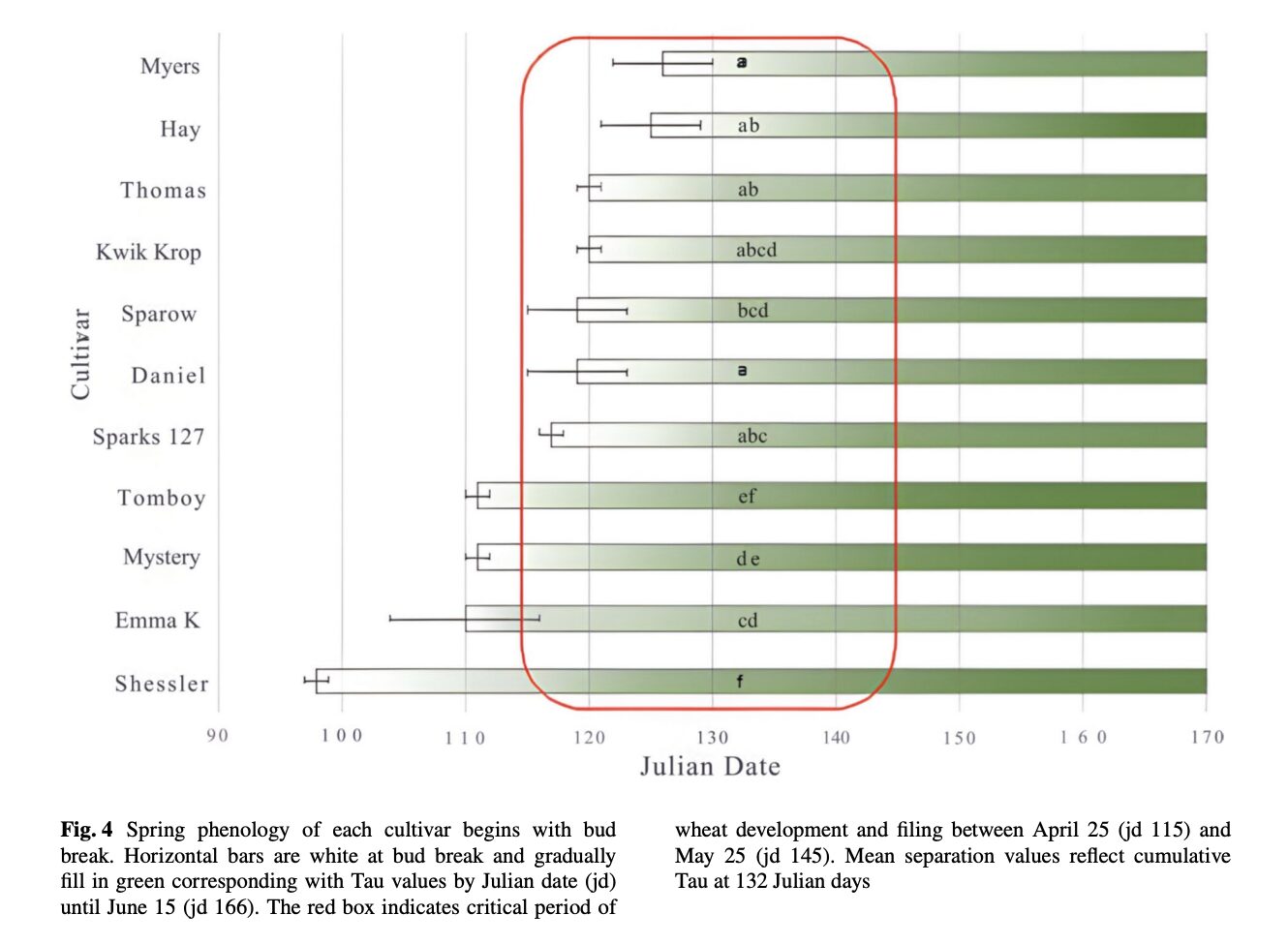
Historical data from Center for Agroforestry researchers indicates that ‘Hay’ and ‘Sparks 127’ are the top performing cultivars included in this study due to their high kernel percentage and overall yield. This study shows that these two cultivars may be particularly well suited to winter alley cropping applications. Their phenological qualities result in relatively late bud break (especially ‘Hay’), while the architectural qualities of their canopy allow for significant light to penetrate the ground as leafing progresses.
New and upcoming releases, like ‘Hickman’, were not included in the experiment design and warrant further study. Hickman’s parents are ‘Sparks 127’ and ‘Football’.
This research took place at the MU Horticulture and Agroforestry Research Farm in New Franklin, Missouri (USDA Hardiness Zone 6b), where our researchers steward a large collection of high yielding, quality black walnut cultivars in addition to several thousand breeding progeny currently under evaluation for future commercial suitability. Employing a wand-like sensor called an AccuPAR, scientists took hands-on data measurements beneath the trees to investigate the quality of light coming through the canopy, referred to as photosynthetically-active radiation transmitted (PARt). Using concise photographic measurement, or photogrammetry, scientists were able to further collect and analyze data around leaf crown sizes and shapes in order to help determine how cultivars share sunlight with understory crops.
Impact & next steps
Tree crop cultivar selection for alley crop systems is a crucial consideration while in the planning and design phase.This research found that there can be a nearly two-fold difference in how much light reaches the ground, depending on the cultivar. Choosing a cultivar like ‘Hay’, with a relatively narrow canopy over more densely structured trees like ‘Kwik Krop’, for example, can allow almost twice as much solar energy to reach the crop below. This information can be utilized on farms to turn fears of solar scarcity into a win-win system design for both crops within a given system.
This research will inform future investigations into mixed species production systems that produce more nutrition on less farmland. Additional inquiry into other black walnut populations, and even other species like pecan and Chinese chestnut, can be used to further discover suitable cultivars for alley cropping. Shade studies such as this may even apply to silvopasture and forest farming scenarios. By identifying the biological blueprints of our most cooperative trees, the Mizzou Center for Agroforestry is decoding a multi-story future for Missouri agriculture.
A note on juglone
While black walnut trees have a reputation for negatively impacting nearby plants through the release of the compound juglone into surrounding soil, modern, peer-reviewed studies on the subject are inconsistent and have illuminated limitations to our understanding of these tree-plant interactions. Observational publications have suggested that juglone toxicity has some influence on the growth of plants in the nightshade family (tomatoes, potatoes, etc.) but little effect on common row crops like corn, beans and wheat. However, to this date, there has been no conclusive in-field experimental evidence to validate claims of black walnut allelopathy. Read more from Washington State University’s Extension Guide on this subject.
Article Citation
Bishop, B., Torralbo, F., Meier, N.A. et al. Characterizing canopy light penetration in black walnut (Juglans nigra) cultivars to inform selection for alley cropping. Agroforest Syst 100, 43 (2026). https://doi.org/10.1007/s10457-025-01377-4
Related Resources
Extension Publications
Peer-Reviewed Publications
This work is supported by the U.S. Department of Agriculture, Agricultural Research Service, under agreement No. 58–6020-0–007, and the University of Missouri Center for Agroforestry and the USDA/ARS Dale Bumpers Small Farm Research Center. Any opinions, findings, conclusion, or recommendations expressed in this publication are those of the author(s) and do not necessarily reflect the view of the U.S. Department of Agriculture.