
Agroforestry Training Academy
The Agroforestry Training Academy is an intensive educational program designed for agriculture and natural resources professionals & farmers to gain an in-depth understanding of agroforestry practices, design concepts, species selection and management, economics and marketing, and more.
5-Week Online Course: April 12 – May 14, 2027
4-Day In-Person Field Experience: May 25 – 28, 2027
Applications Now Open for the 2027 Agroforestry Training Academy
Application form closes December 6, 2026
Due to the unprecedented level of interest in our Agroforestry Academy over the last few years, we are maintaining application-based enrollment for our programming. If you have any questions or clarifications about this process, please contact Kelsi Stubblefield (k.stubblefield@missouri.edu).


About the Agroforestry Training Academy
The Agroforestry Academy takes place as a 5-week online course with an additional 4-day in-person field experience component in Mid-Missouri to complement the online coursework.
The 5-week online course will take place in Canvas, a virtual learning platform, with recorded presentations and extensive course materials; Zoom meet-up and consultation sessions with agroforestry professionals, researchers, and experienced growers; virtual farm tours; and networking opportunities. Each week, approximately 4-6 hours of dedicated time for the course is expected.
The course content includes:
…and more!
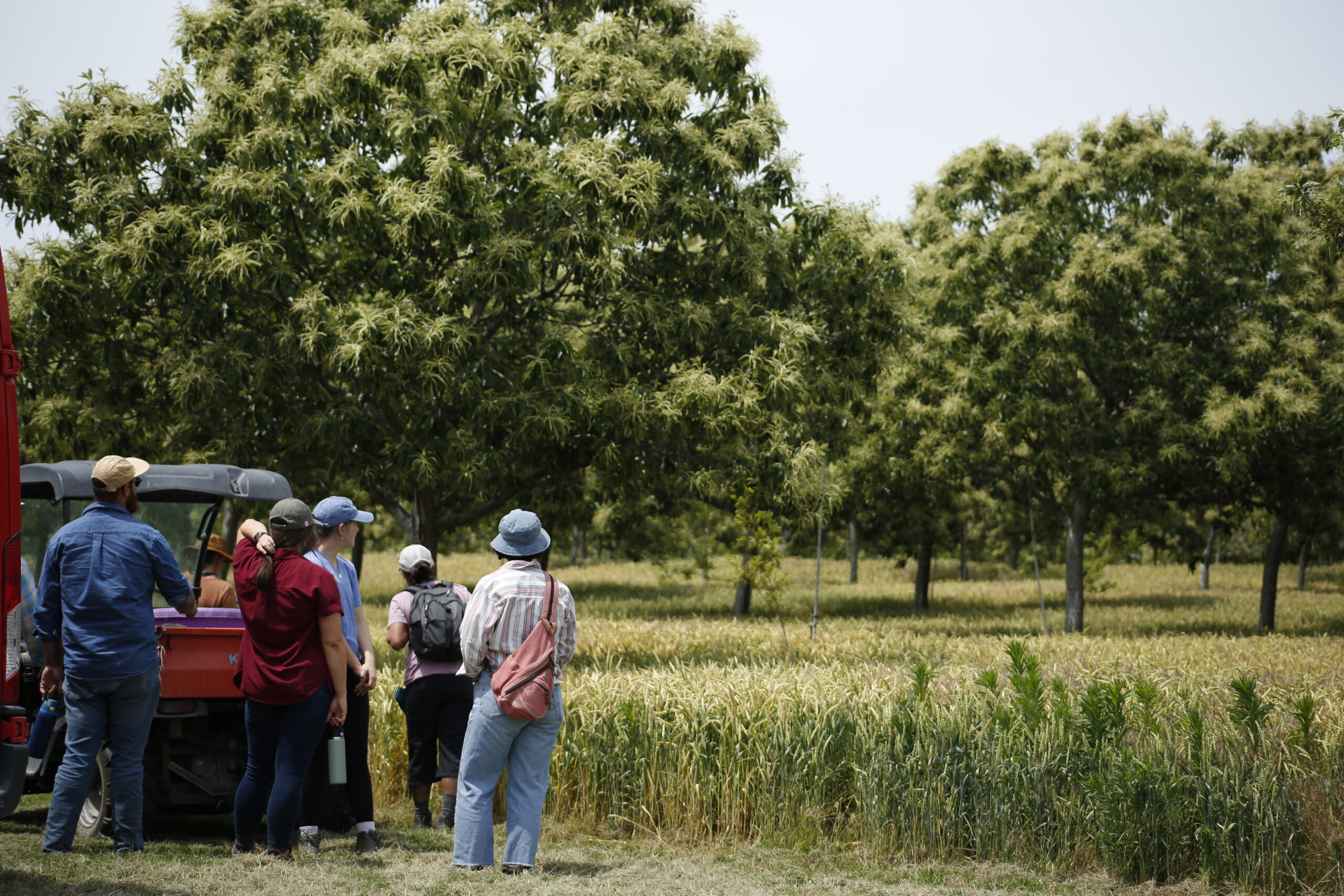
Participants will have the opportunity to meet with instructors and farmers to discuss their plans, progress, questions, and insights. These direct consultation sessions are ideal for those just getting started on-the-ground, for professionals seeking to learn and apply this information in their work, and for those looking to expand their network of agroforestry practitioners as mentors.
The 4-day field experience portion of the academy will take place in Mid-Missouri and will feature 8 farm visits with hands-on learning opportunities at each site to help ground the agroforestry content knowledge covered in the online course, and to empower participants with peer learning and knowledge exchange.
Past field experiences Have featured These Visits & Activities & More:
For questions about the Academy, please contact Kelsi Stubblefield at k.stubblefield@missouri.edu or by phone at (573) 884-3161.
2027 Academy Pricing:
Please note: prices are subject to change each year.
$800 (5-week online course only)
Includes all course materials (electronic and/or hard copies), weekly discussions with agroforestry producers/researchers, and access to Canvas course for one year.
$1,800 (Online course + 4-day in-person field experience)
Includes all course materials (electronic and/or hard copies), weekly discussions with agroforestry producers/researchers, access to Canvas course for one year, and enrollment in the 4-day field experience. All food and lodging costs included in this fee.
If cost limits your ability to attend or you would like more information about available financial support, please contact Kelsi Stubblefield (k.stubblefield@missouri.edu)
Program Background
Agroforestry offers a novel approach to land management that provides opportunities to combine productivity and profitability with environmental stewardship, resulting in healthy and sustainable agricultural systems that can be passed on to future generations. To advance adoption of agroforestry as a cornerstone of productive land use, a week-long agroforestry academy was developed and offered first in 2013 by a regional consortium of experts from Missouri, Iowa, Nebraska, Minnesota and Wisconsin.
The Agroforestry Academy is now an annual offering through the MU Center for Agroforestry. The Academy is designed to train farmers as well as natural resource professionals, extension agents, and other agricultural educators who work with farmers and land managers. Advanced training is provided on temperate zone agroforestry practices integrated with options for processing and marketing, social and economic dimensions, and ecosystem services.
The central activity of the program is an applied planning and design exercise. Academy trainees gain hands on practice in agroforestry design based on the needs of a working farm. Academy trainers and graduates form the core of the knowledge infrastructure needed to enhance farmer/landowner adoption of agroforestry, resulting in increased sustainability of rural communities and agricultural systems.
Past Instructors & Featured Farmers
Sarah Lovell, PhD, Former Director of the Center for Agroforestry
Michael Gold, PhD, Associate Director of the Center for Agroforestry
Hannah Hemmelgarn, Assistant Program Director at the Center for Agroforestry
Ashley Conway, PhD, Silvopasture Faculty at the Center for Agroforestry
Ron Revord, PhD, Tree Crop Breeding Faculty at the Center for Agroforestry
Zhen Cai, PhD, Agroforestry Economics Faculty at the Center for Agroforestry
Dusty Walter, PhD, University of Missouri College of Agriculture, Food and Natural Resources
Patrick Byers, University of Missouri Extension, Field Specialist in Horticulture
Andy Thomas, University of Missouri Southwest Research Center, Research Assistant Professor
Lauren Cartwright, Missouri Natural Resources Conservation Service EQIP Coordinator
Joe Alley, Missouri Natural Resources Conservation Service State Forester
Richard Straight, USDA National Agroforestry Center, Lead Agroforester
Kate MacFarland, USDA National Agroforestry Center, Agroforester
Leo Sharashkin, PhD, Horizontal Hive, Forest Beekeeper
Greg Judy, Green Pastures, silvopasture practitioner
Eliza Greenman, HogTree, silvopasture practitioner
Stesha Warren, Eliana’s Garden, forest farming practitioner
John F. Munsell, Virginia Tech forestry faculty, forest farming outreach
Katie Commender, Appalachian Sustainable Development, Appalachian Harvest Herb Hub
Bill Stouffer, Cedar Hill Farms, chestnut and elderberry producer
Kathy Dice, Red Fern Farm, producer – pawpaw, chestnut, and many other specialty perennial crops
Terry Durham, River Hills Harvest, elderberry producer
Austin Unruh, Crow & Berry Land Management, and Trees for Graziers, silvopasture and buffer practitioner
John Hendrickson, University of Wisconsin, Madison Center for Integrated Agricultural Systems, Farm Viability Specialist
Emily Wright, Greenbelt Land Trust of Mid-Missouri president and Three Creeks Farm & Forest producer
Roger Blackwell, Chestnut Growers of America president
Greg Miller, Route 9 Chestnut Cooperative
Catherine Bukowski, Kindred Roots Design, author of The Community Food Forests Handbook
Josh Payne, chestnut and hazelnut producer, sheep silvopasture practitioner
…and many more!