
New research shows increasing demand for American elderberry products and price premium for American-grown berries
By Kelsi Stubblefield
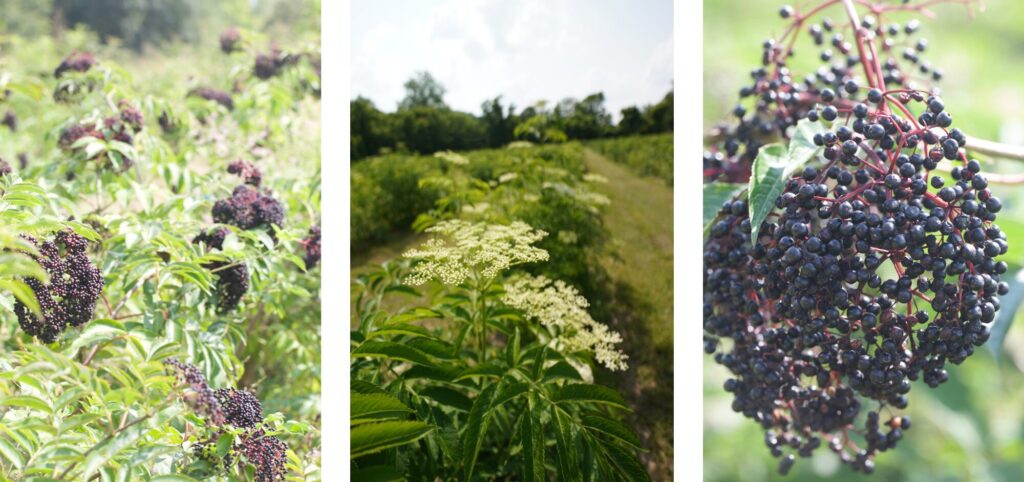
Indigenous to the eastern and midwestern United States, the American elderberry (Sambucus nigra subsp. Canadensis) is a versatile berry crop with strong antioxidant properties that can be used in many different foods and drinks such as teas, juices, cordials, syrups, jams, and more. Research suggests that the market for such products is growing, and a recent study supported by the Advancing American Elderberry Project and the Center for Agroforestry reports that consumer demand has dramatically increased over the past decade.
Researchers surveyed 1,036 U.S. consumers and found that 41% had consumed elderberry products, a nearly six-fold increase since 2011. Elderberry-based vitamin supplements were purchased most frequently by respondents, and elderberry juice was the second most popular item. Participants were also asked what influenced their food purchasing decisions. Most rated ‘taste’ as the most important factor in their purchasing choices, with ‘price’ and ‘nutrition’ as the second and third most influential factors.
Researchers also applied a discrete choice experiment, which allowed them to estimate the price that consumers were willing to pay for certain product attributes such as pesticide-free or organic production, American-grown elderberries (versus the more widely available, imported European elderberry), and a carbon-neutral label. Findings suggested that consumers were willing to pay, on average, $3.51 more for a bottle of juice with organically grown elderberries, $3.97 more for pesticide-free elderberries, and $1.91 more for juice with a carbon-neutral footprint. Respondents would pay $2.00 more for juice with American-grown elderberries. Additionally, when all other attributes were held constant, consumers were 99.7% more likely to buy a bottle with American-grown elderberries than European elderberries.
Findings from this study illuminate the high demand for American-grown elderberry products and will help to create a roadmap for future research to support this budding industry. Elderberry growers and value-added processors can also benefit from these findings and use them to inform marketing and sales decisions.
Read the full, open-access article in HortScience today.Cai, Z., Stubblefield, K., Thomas, A. L., & Aguilar, F. X. (2024). From Niche to Mainstream: US Consumer Trends and Preferences for Elderberry Products. HortScience, 59(12), 1723-1729. Retrieved Jan 28, 2025, from https://doi.org/10.21273/HORTSCI18180-24