
Center for Agroforestry releases new eastern black walnut cultivar UMCA® ‘Hickman’ for nut production
The Center for Agroforestry has released a new black walnut cultivar for high-quality orchard nut production, a new milestone in our tree crop improvement program that spans nearly three decades.
Scientists at the Center for Agroforestry began curating cultivars of nut-producing eastern black walnut (Juglans nigra L.) in 1996. A few years later, in 2002, researchers established the first generation of offspring to kick off our signature black walnut breeding program. Today, the program includes breeding blocks of 2,100 progeny from 35 families, 550 trees in cultivar trials, and 126 genotypes preserved in our repository.
“Black walnut is an emerging orchard crop with great economic potential in Missouri and the Midwest,” said Ron Revord, interim director of the Center for Agroforestry. “Our hope is that our UMCA® ‘Hickman’ cultivar release will increase orchard adoption – and thus spur industry growth – as Hickman’s prolific bearing habit helps improve early yields and return on investment for growers.”
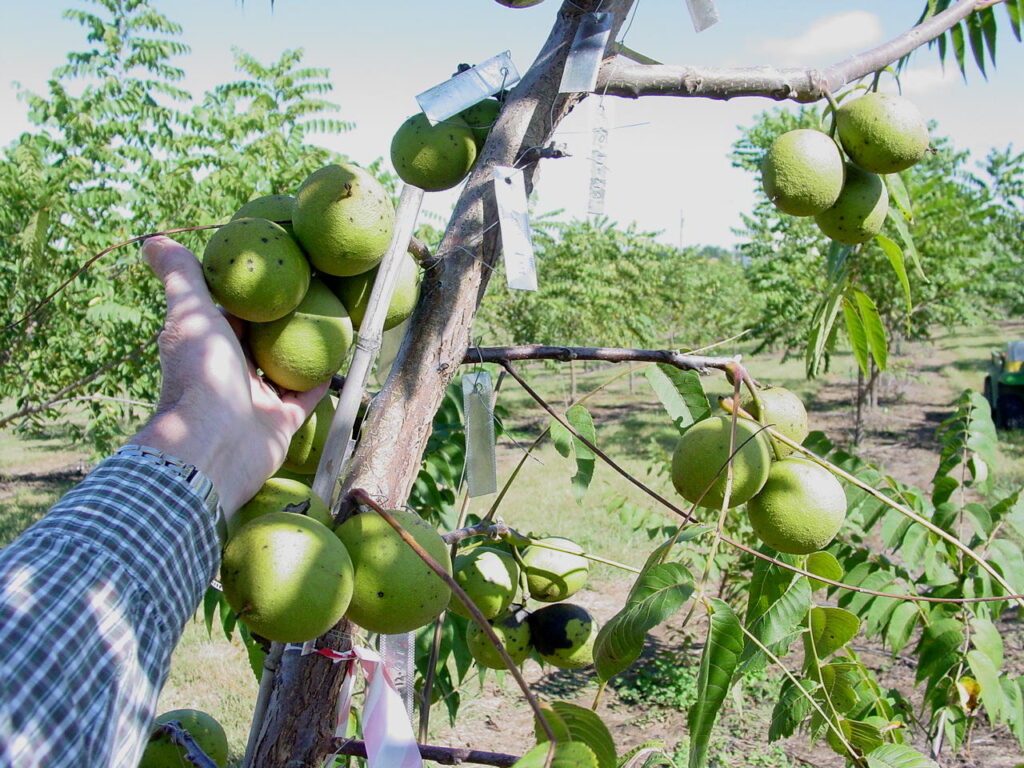 Hickman’s spur-bearing habit
 An example of Hickman’s vegetative growth
 Black walnut seedling block at the MU Horticulture and Agroforestry Research Farm
Missouri’s black walnut industry currently relies on nuts harvested from wild trees. While wild black walnut trees are abundant in Missouri and provide a solid backing for the industry, black walnut cultivars suited to orchard cultivation for nut production could help solve some of the industry’s biggest obstacles. Black walnuts are a masting species, leading to inconsistent supply during non-masting years. Even in seasons with abundant production, nut size and quality can vary dramatically among wild trees, resulting in processing issues and price variations.
To support the walnut industry in Missouri, the Center for Agroforestry’s improvement program looks for promising selections that exhibit the following characteristics:
UMCA® ‘Hickman’ performs desirably in the majority of these categories. It is the highest-yielding tree among the 120 seedlings established in our 2002 breeding generation, as well as the earliest to bear nuts at five years old. UMCA® ‘Hickman’ can alternately bear under low-input conditions. However, this tendency can be minimized with management, and average yields tend to outperform the most promising consistently bearing trees. As UMCA® ‘Hickman’ reaches maturity, yields are comparable to cultivars ‘Sparrow’ and ‘Neel’, surpassing typical yields of ‘Football’. UMCA® ‘Hickman’ kernel weight averages 5.1 grams with kernel percentage reaching 36 percent in years with ample rainfall in Missouri (wild nuts typically span 10-14 percent). Compared to other available black walnut cultivars, UMCA® ‘Hickman’ produces high yields of desirable nuts early in life, continuing well into maturity.
Currently, Hammons Products Company in Stockton, MO is the only commercial black walnut processor in the U.S. Hammons is located in Stockton, MO, with 196 buying stations across the Midwest mainly set up to purchase walnuts from native, wild trees. Hammons also purchases clean, dry walnuts from orchards of improved cultivars with premiums ranging from $0.50 to $1.20 per pound in-shell. Some growers market cracked nuts or cleaned black walnut kernels direct to consumer with premiums ranging from $10 to $20 per pound. (Note: this information was last updated in our 2022 technical guide on black walnut, linked blow).
Interested in establishing a black walnut orchard? Check out the Center for Agroforestry’s black walnut orchard establishment guide.
Contact blackwalnut@missouri.edu for more information on Hickman availability.
Black walnuts are a rich source of fatty acids and contain the highest protein content of any tree nut, as well as vitamins and minerals such as vitamin A, vitamin B-6, manganese, iron, phosphorus, potassium, magnesium, copper, and selenium. They are a source of the omega-3 fat alpha-linolenic acid, which is linked to lowering cholesterol, regulating heartbeat, and reducing inflammation. Their rich, distinctive flavor lends itself to a variety of recipes and they have a long storage life: up to one year in an airtight container in the fridge and up to two years in the freezer.
Read the full ‘Hickman’ patent:
Coggeshall, M.V. Revord, R. S., & Meier, N.A. (2025). Walnut Tree Named ‘Hickman’ (United States Patent PP36382). The Curators of the University of Missouri (Columbia, MO, US). https://www.freepatentsonline.com/PP36382.html
This invention was made with government support under Grant No. 58-6020-0-007 awarded by the Agricultural Research Service.